What if the thing you think is the thing…. isn’t the thing?
I was reminded recently of the 2008 film Frost/Nixon. What stays with me (beyond the fantastic acting and writing) isn’t just the politics — it’s the shift in attention.
In the film, David Frost is focused on one thing: selling his interviews with Richard Nixon after Watergate. He needs the deal - his financial survival depends on it.
But the more he chases the sale, the worse the interviews become. Nixon controls the narrative, says very little and keeps the upper hand.
Then something shifts.
Frost stops focusing on the sale and turns his attention to what really matters — the conversation itself, and the relationship in the room.
That’s when everything changes. The interviews land. Nixon falters. The moment everyone remembers happens. And only then do the networks come running.
A familiar dynamic
I often see this dynamic play out in my work with leaders and teams.
Part of my role is helping people get clear on “the thing.” Very often, the thing they think is the thing — isn’t actually the thing.
I was recently working with a team under pressure to secure funding. Understandably, all their attention was on chasing the next opportunity, the next conversation, the next proposal. But when we slowed things down — just for a moment — something else came into view. They began to see how much of their past success had come not from relentless pursuit, but from the quality of their relationships. The trust they had built. The way they worked together and with others.
Paradoxically, when their attention moved away from funding, they saw much more clearly how to approach it.
Finding “the real thing”
Early in any piece of work, there’s often a pull to move quickly — to fix, to act, to deliver. But what if you slowed things down….just a little?
Stay curious a little longer
Resist the pressure to “do” too soon
Pay attention to what is actually here
Not as a passive move — but as a different kind of discipline. Because it’s in that space that patterns begin to emerge. Connections that weren’t visible before start to form.
And often something more precise, more truthful, comes into focus.
The paradox of “not doing”
There’s a paradox at the heart of this. What looks like not doing often creates far more impact than constant activity. As Herb Stevenson describes in Bare Attention, when leaders shift from constant doing into presence, they often see:
Less burnout
More engagement
Fewer initiatives
Greater impact
Less control, but stronger accountability
It’s not about doing nothing. It’s about doing from awareness, rather than from urgency.
Herb Stevenson offers a neat model where we can locate ourselves from Over-doing to Emergence.
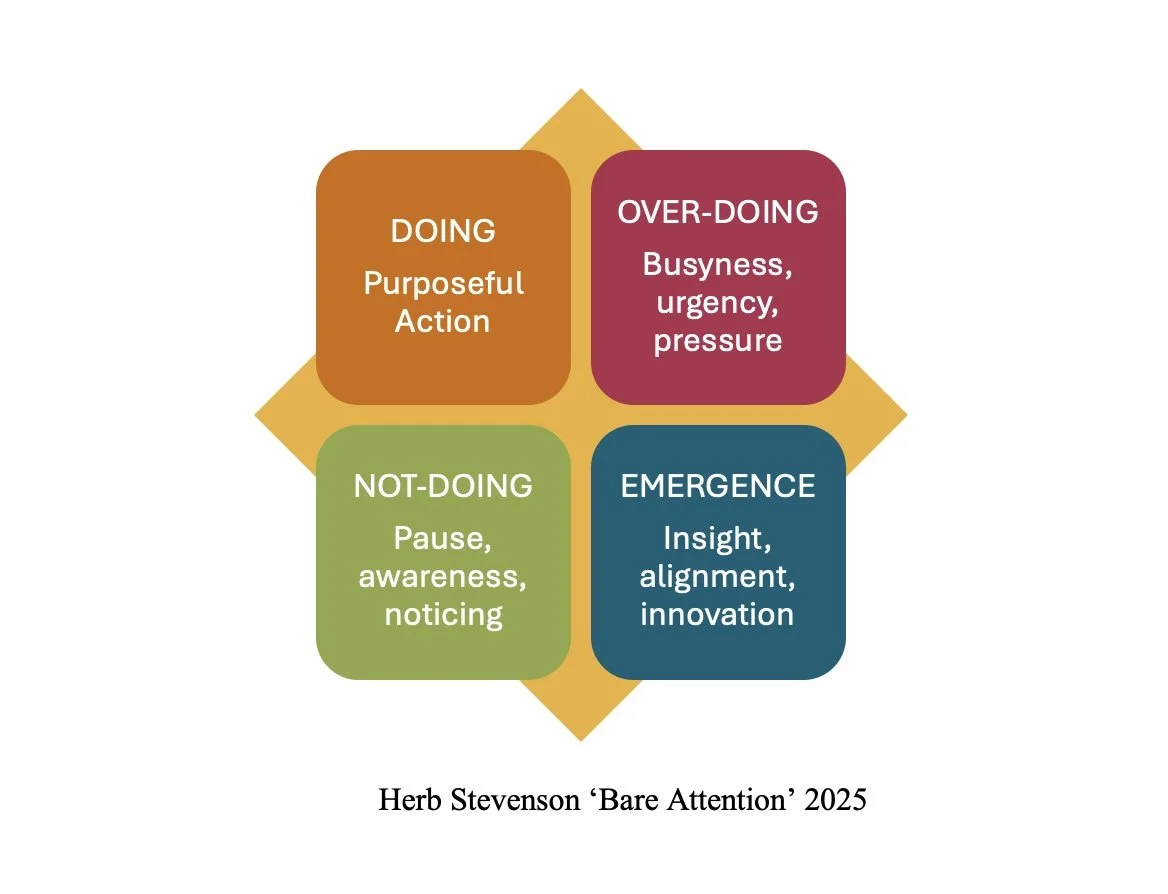
(4-box model showing what’s set out below)
You might recognise yourself somewhere on this model right now. Here are some questions to help you locate where you are:
Doing (Purposeful Action)
What am I intentionally choosing to move forward right now?
Does my activity feel aligned with what really matters?
Over-doing (Busyness)
Where am I staying busy instead of being effective?
What might I be avoiding by keeping the pace high?
Not doing (Pause/Awareness)
What happens if I stop, even briefly, and pay attention to what’s here?
What am I noticing that I might otherwise miss?
Emergence (Insight & Innovation)
What new clarity is beginning to form?
What feels more simple or obvious now than it did before?
The real edge
The pull to do is strong. It gives us a sense of certainty, control and movement. But the real edge for many leaders isn’t doing more – it’s learning differently. Chris Argyris described three levels of learning:
Single-loop: Am I doing things right?
Double-loop: Am I doing the right things?
Tripple-loop: How am I thinking and showing up?
Most organisations stay in the first – doing more, faster. The shift begins when you pause and ask:
Is this actually the right problem?
What assumptions am I making?
What is the part I’m playing in this situation?
Questioning whether “the thing is actually the thing” takes us somewhere else — into the unknown. That can feel uncomfortable - even risky. This is where a developmental stance matters – seeing the unknown not as something to avoid, but as a space of potential.
With it, something else becomes possible – clearer thinking, better choices, and more aligned action. When we step out of the familiar rhythmn of doing, we find what actually needs our attention.
So perhaps the question isn’t just: What’s the thing I need to do?
But: What am I not yet seeing?
And: What if the thing I think is the thing… isn’t the thing at all?
If this resonates or you’d like to find out more, please get in touch here, I’d love to hear from you.